
Criminal Court Cases in Buncombe County
Buncombe County criminal court cases belong to North Carolina's unified General Court of Justice. District Court handles misdemeanors, infractions, probable-cause work, and the preliminary stages of felony matters. Superior Court conducts felony trials after indictment. Both sit at the Buncombe County Courthouse, and the county is Judicial and Prosecutorial District 40. There is no separate city criminal court for Asheville, Black Mountain, or Woodfin. A city citation or police arrest that becomes a filed prosecution therefore moves into the same Buncombe County court system.
The Clerk of Superior Court is the custodian of the official case file. Its main number is 828-259-3400, and Criminal Records can be reached at 828-259-3402. The public eCourts index is useful for discovery, but the clerk supplies copies and certified results. Odyssey case numbers combine a year, case-type letters, a six-digit sequence, and a county identifier. That exact number is the safest key for matching a docket to a charge.
Buncombe County Court Divisions
The court division tells a reader which events to expect. A misdemeanor generally remains in District Court. A felony may begin there for its initial appearance and preliminary work, then proceed to Superior Court after a grand jury returns an indictment. The criminal magistrate at 20 Davidson Drive handles initial criminal process and release conditions. Only a judicial official can set or alter bond. The District Attorney, based at 60 Court Plaza, evaluates referrals, selects filed charges, and handles pleas and trials.
Buncombe County also operates Adult Drug Treatment Court and Veterans Treatment Court within its justice system. These are specialty programs, not separate sources of public criminal history. The underlying charge, hearings, disposition, and judgment still belong in the clerk's case record. A reader should follow the docket rather than infer an outcome from a program referral.
Buncombe County Courthouse
60 Court Plaza
Asheville, NC 28801
828-259-3400
Monday-Friday, 8 a.m.-5 p.m.
Criminal Records
60 Court Plaza
Asheville, NC 28801
828-259-3402
District and Superior Court files
Buncombe County Case Record Searches
The North Carolina eCourts Portal is the main remote index for Buncombe County case records. Search an exact case number when available. A party-name search works best with accurate spelling, though a broad search can help when the middle name is uncertain. Choose Buncombe County and a criminal case category before reviewing results. Portal configuration can change, and some document functions may require registration or payment even though the public index search is free.
- Open eCourts Portal and choose the case or party search route.
- Enter the exact case number, or search the party as last name and first name.
- Filter the location to Buncombe County and the category to criminal or infraction records.
- Open the matching docket and review each charge, event, hearing, disposition, and finance entry.
- Contact the Buncombe County clerk for a document that is missing online or for an official certified result.
| Field or Control | Type | Required | Use |
|---|---|---|---|
| Smart Search | Text | One search basis | Name or case number, following portal syntax |
| Last or Business Name | Text | For name route | Exact spelling gives a tighter result |
| First and Middle Name | Text | Optional | Narrows common names |
| Case Number | Text | Alternative | Best exact identifier |
| Location or County | Filter | No | Select Buncombe County for local files |
| Case Type and Dates | Filters | Optional | Separate criminal actions and limit long lists |
Official wildcard rules require at least four characters before an asterisk in a case-number search. A person search needs at least three last-name characters plus an asterisk and at least one first-name character plus an asterisk. Use fewer optional fields when spelling is in doubt, then confirm the result from the docket details.
Buncombe County eCourts Tools
The North Carolina Judicial Branch eCourts hub shows the service layer behind Buncombe County's online court access. Its public tools help locate the right case before a request goes to the clerk.
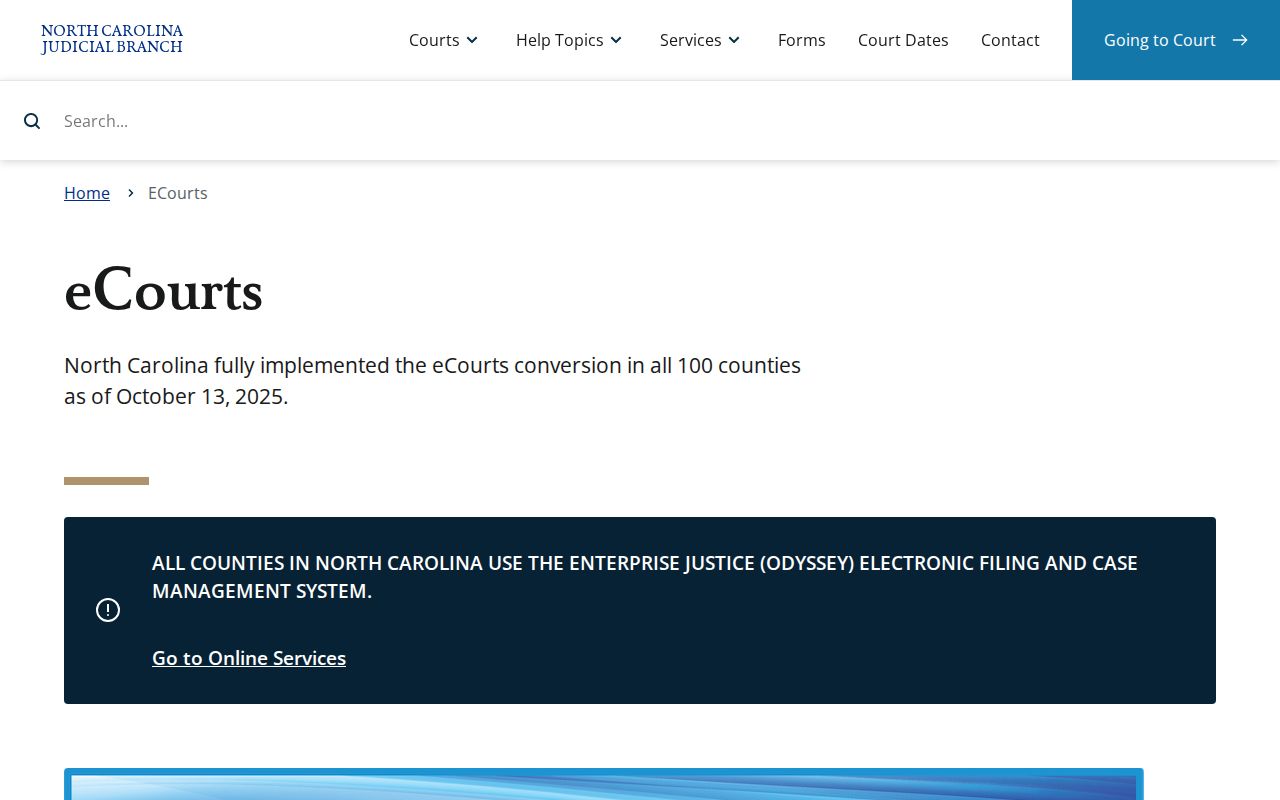
The service screen is a starting point, not a substitute for a certified Buncombe County criminal case file. Court Portal is near-real-time public information. An older paper item or non-imaged document may still require a clerk search at the courthouse.
Note: Link a Portal result to its Buncombe County clerk file before relying on a docket entry as the final court record.
What a Criminal Case File Contains
A Buncombe County court file centers on the prosecution after filing. It may show a charge that differs from the original booking claim because the prosecutor can amend, replace, or decline an arrest allegation. Read every charge row. One count may be dismissed while another ends in judgment, so a case-level status alone can hide the result that matters. Docket events are procedural entries and are not proof that an allegation is true.
| Case Number and Court | Unique Odyssey identifier, Buncombe location, case type, and filing date |
|---|---|
| Parties and Counsel | Public party names, attorneys, and judicial assignments when displayed |
| Filed Charges | Charge description, statute, class, and the filed court allegation |
| Docket Events | Chronological motions, process, notices, and other case activity |
| Hearings | Scheduled court events and their recorded outcomes |
| Disposition | Result and date for each charge, such as dismissal, acquittal, or conviction |
| Judgment and Finances | Sentence, assessments, payments, balances, and document references where public |
Note: Read each Buncombe County charge row separately because one criminal case can contain several counts with different final dispositions.
Buncombe County Docket Terms
North Carolina docket language separates an event from an outcome. A calendar only reports when a matter is scheduled, and the listing can change. A disposition records how a charge ended. Judgment is the court's formal result and sentence. These distinctions matter in Buncombe County case research because a booking entry, an open charge, and a conviction answer different questions.
- Arraignment
- The formal stage at which the defendant responds to the charge.
- Docket
- The chronological record of events in a court case.
- Disposition
- The result attached to an individual charge.
- Dismissal
- A charge ended without a conviction.
- Prayer for judgment continued
- A North Carolina disposition that delays entry of judgment.
- Judgment
- The court's formal outcome and sentence.
The District Attorney for Prosecutorial District 40 decides which charges to prosecute and handles plea or trial work. The official source page offers local context for that role.
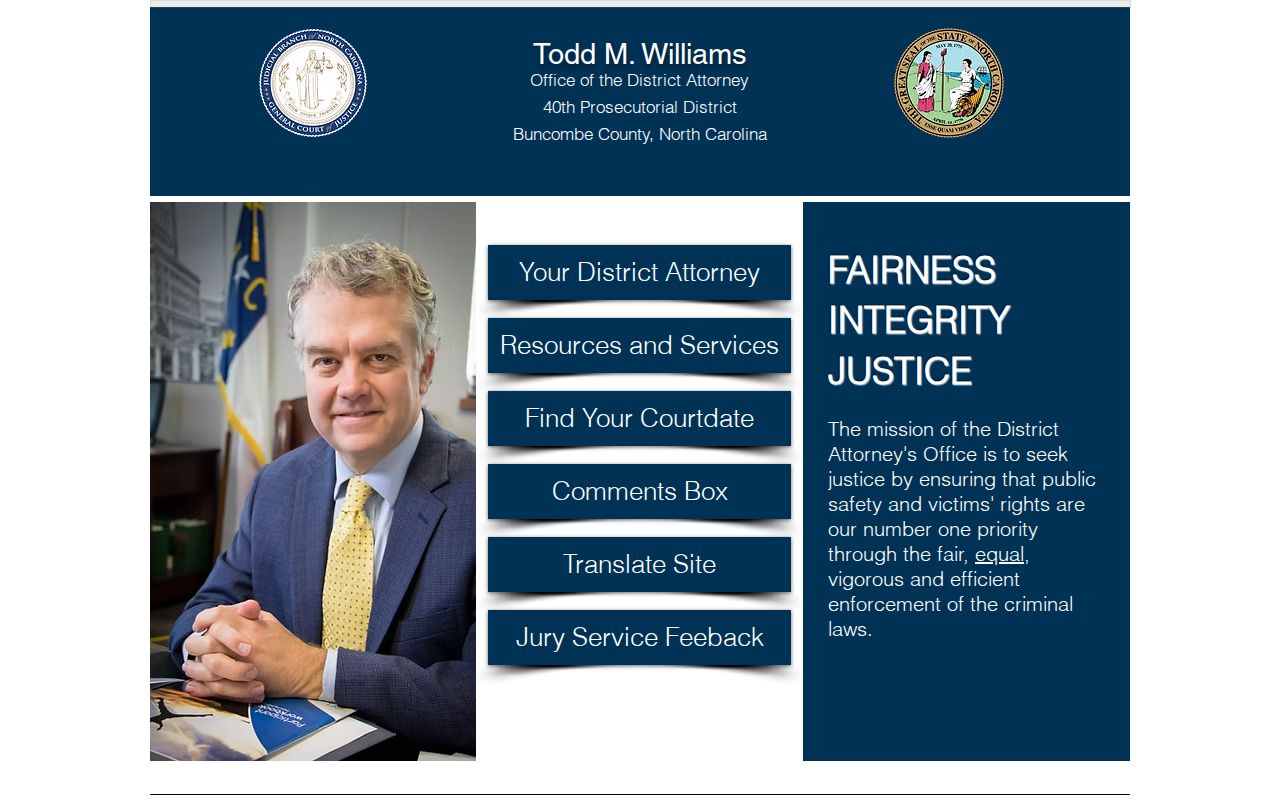
The prosecution office is not the case-record custodian. Requests for the docket, judgment, or certified result still belong with the Buncombe County clerk.
Criminal Case Stages in Buncombe County
A Buncombe County criminal matter can start with arrest, citation, or other judicial process. An initial appearance addresses the accusation and release terms. Misdemeanors follow the District Court track. Felonies pass through preliminary work and may move to Superior Court after indictment. Motions, a plea, or a trial lead toward the result, followed by judgment and any appeal. The time between steps varies by the facts and court schedule, so the docket should be used instead of a guessed timetable.
Case flow: Charges Filed → Arraignment → Pretrial → Plea or Trial → Disposition → Sentencing
A scheduled court date is not a criminal history by itself. Likewise, an arrest charge is not necessarily the prosecutor-filed charge. Readers tracing the earlier intake event can compare it with the separate Buncombe County arrest search, then return to the court disposition for the filed result.
Court Plaza Access in Buncombe County
The Buncombe County Courthouse at 60 Court Plaza is open weekdays from 8 a.m. to 5 p.m. County Justice Services recommends arriving 30 minutes before court. Visitors enter at street level, pass a metal detector, and have bags screened. The paid county parking deck is across the street at 164 College Street. Elevators reach all public office floors. Anyone unable to use stairs in an emergency should notify court security.
This access pattern reflects the courthouse's history. The 1927, 15-story building later gained a nine-story life-safety tower, new security entry, four public elevators, separate prisoner elevators, secure parking, and a prisoner bridge. The design keeps public, judicial, and detainee movement apart. That is why a detention transfer can occur without movement through the public lobby.
Note: Call Criminal Records at 828-259-3402 before visiting when the needed Buncombe County case document is older or not imaged online.
Access Rules for Case Records
North Carolina G.S. 7A-109 makes clerk records public subject to law and remote-access limits. A public index may omit juvenile matters, sealed or expunged files, protected addresses, victim-sensitive data, Social Security numbers, and other confidential details. A missing search result therefore does not prove that no record ever existed. It may point to a restricted record, an older paper file, a name mismatch, or an item that has not been imaged.
For a certified county result, the Judicial Branch publishes the criminal record check procedure and AOC-CR-314 request route. The stated fee is $25. Buncombe's City-County Division of Identification separately advertises a $5 Buncombe-only court-case check with a 24-hour processing period. Neither product is a general-public statewide NCSBI name search. Mail payments to the court accept money order or certified check, not a personal check; courthouse payment can include cash, card with a processing fee, money order, or certified check.
Federal Court Cases in Buncombe County
Federal criminal cases use a different system. Buncombe County is in the Western District of North Carolina, Asheville Division. Its federal clerk is at the U.S. Courthouse, 100 Otis Street, Room 309, Asheville, and the phone is 828-771-7200. Public counter hours are weekdays from 8:30 a.m. to 12:30 p.m. and 1:30 to 4 p.m. North Carolina eCourts does not hold these federal dockets.
The official PACER service is the federal search channel. At the research date, it charged $0.10 per page, generally capped a case-specific document or report at $3, and waived a quarter's total when it was $30 or less.
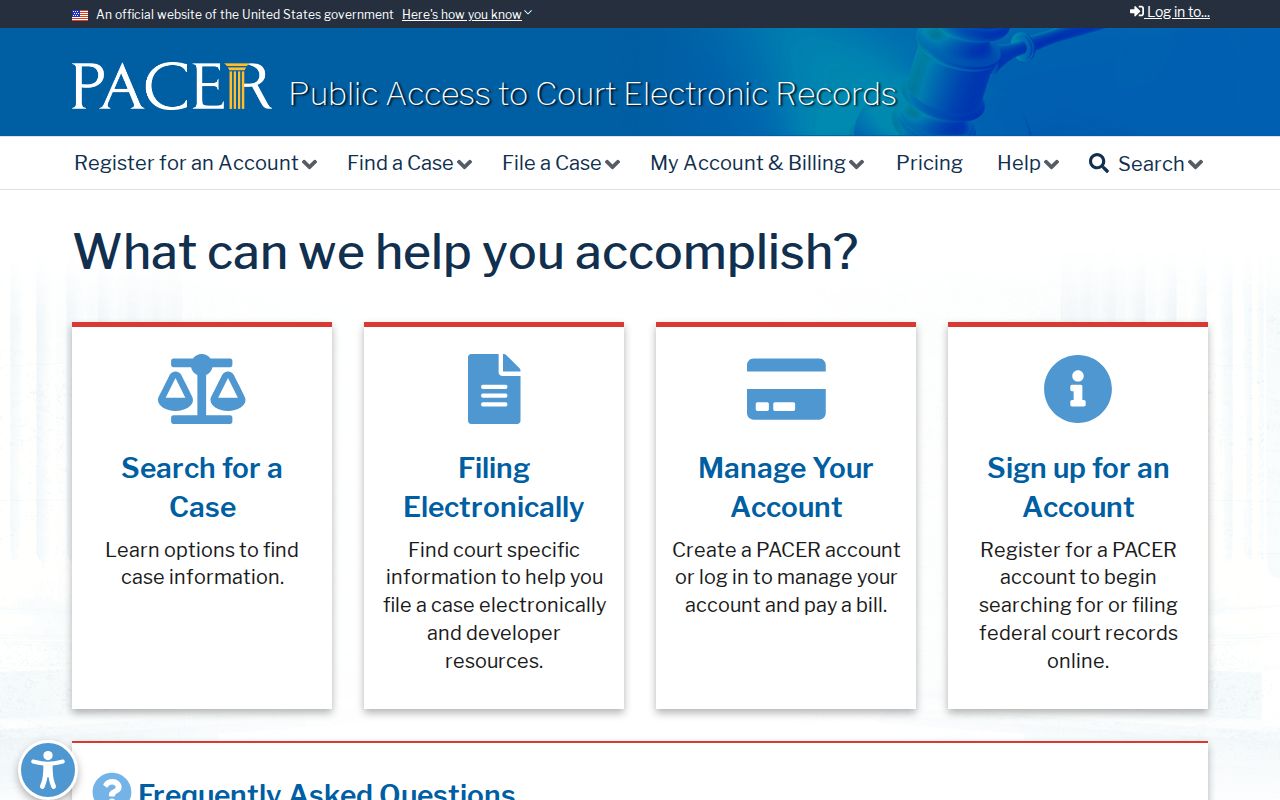
The PACER interface shown here belongs only to federal court records. State felonies and misdemeanors filed in Buncombe County remain in eCourts and with the clerk at 60 Court Plaza.