
Asheville Criminal History Checks
An Asheville record check works best when the first search matches the record's source. Asheville Police Department creates the report for events handled by its officers. Buncombe County detention staff create the custody record after an arrest. The Clerk of Superior Court maintains the filed criminal case. The North Carolina State Bureau of Investigation holds fingerprint-linked state criminal history, but it does not offer a general public name-search site. Those boundaries explain why a report can appear in one system before it appears in another.
Use the known case or report number whenever possible. A name alone can return people with similar details, while a number connects the search to one event. The main sequence is:
- Search the Asheville Police-to-Citizen portal for the city incident, event, or arrest report.
- If the case number is unknown, use the city's map tools to find the event by date and place, then return to P2C.
- Check Buncombe Sheriff P2C for a booking or current custody record after an Asheville arrest.
- Search North Carolina eCourts under Buncombe County for filed charges, hearings, and the disposition.
- Request a certified Clerk search or an NCSBI Right to Review when the purpose requires that distinct official product.
Asheville P2C Record Search
The Asheville Police-to-Citizen portal publishes events, arrests, and incidents described by the city as covering 2003 to the present. Most published incident and crash reports after January 1, 2003 can be found and downloaded. Search by the exact APD case number first. If a report has not been published, an empty result does not prove that the event did not occur. The file may require a records request, may still be under review, or may contain material that state law allows the agency to withhold.
The official APD P2C source shows the public entry point used for an Asheville police record.
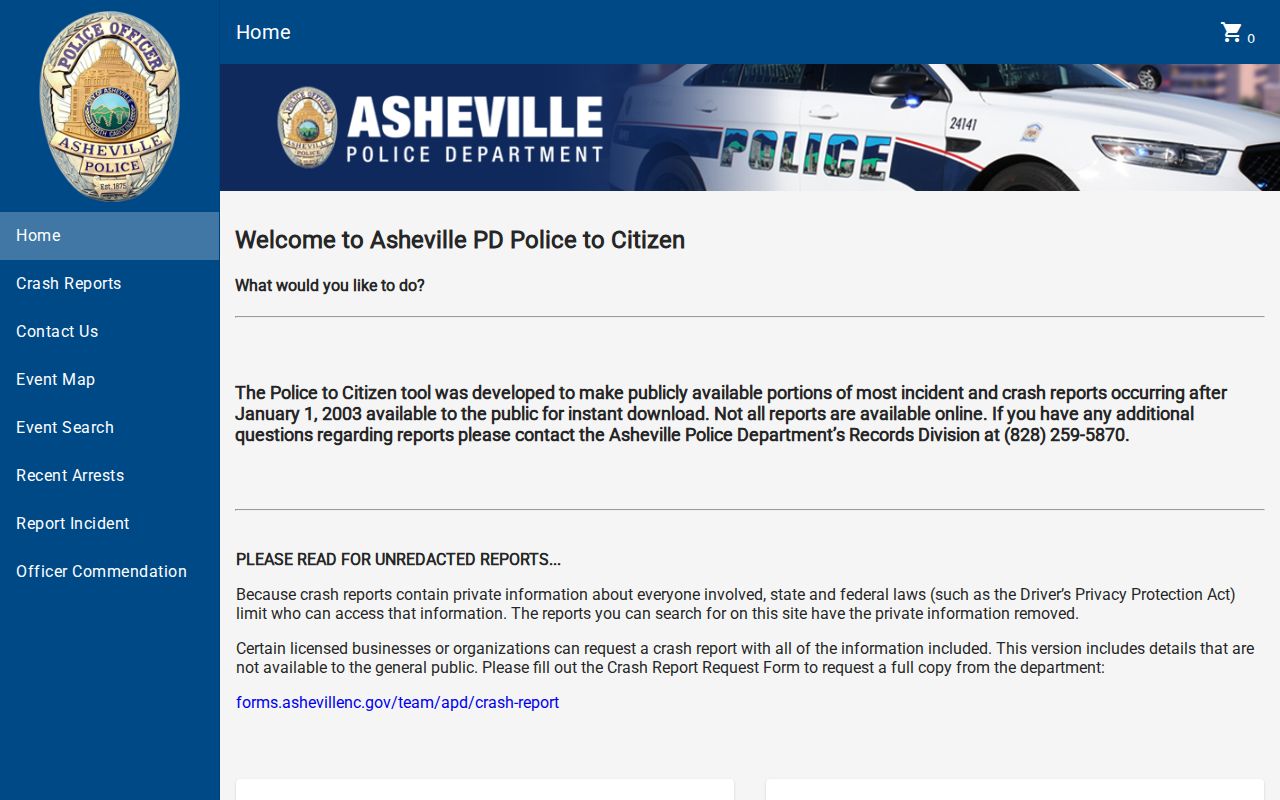
This interface is the local report layer, not the final Buncombe court disposition or a statewide fingerprint record.
| Search control | Use | Limit |
|---|---|---|
| Case number | Best match to an exact APD report | Requires the city identifier |
| Date or range | Narrows an event search | Use with place or type |
| Location | Finds block-level public events | Public display may be less exact |
| Event type | Filters P2C or Crime Map results | Reported event is not a conviction |
| Download or print | Retrieves an available PDF | Only works when the report is published |
Records at the Asheville Police Department
Asheville Police Records operates at 100 Court Plaza. The main and nonemergency number is 828-252-1110, and Records is 828-259-5870. Official sources list overlapping service windows, including general records hours of Monday through Friday, 7:30 a.m. to 5 p.m., and records-lobby guidance of 8:30 a.m. to 5 p.m. Call before making a special trip so the counter can confirm the right service time. Mail requests go to APD Records Unit, PO Box 7148, Asheville, NC 28802, with a self-addressed stamped envelope.
The Asheville Police Department page identifies the city agency behind these criminal and incident records.
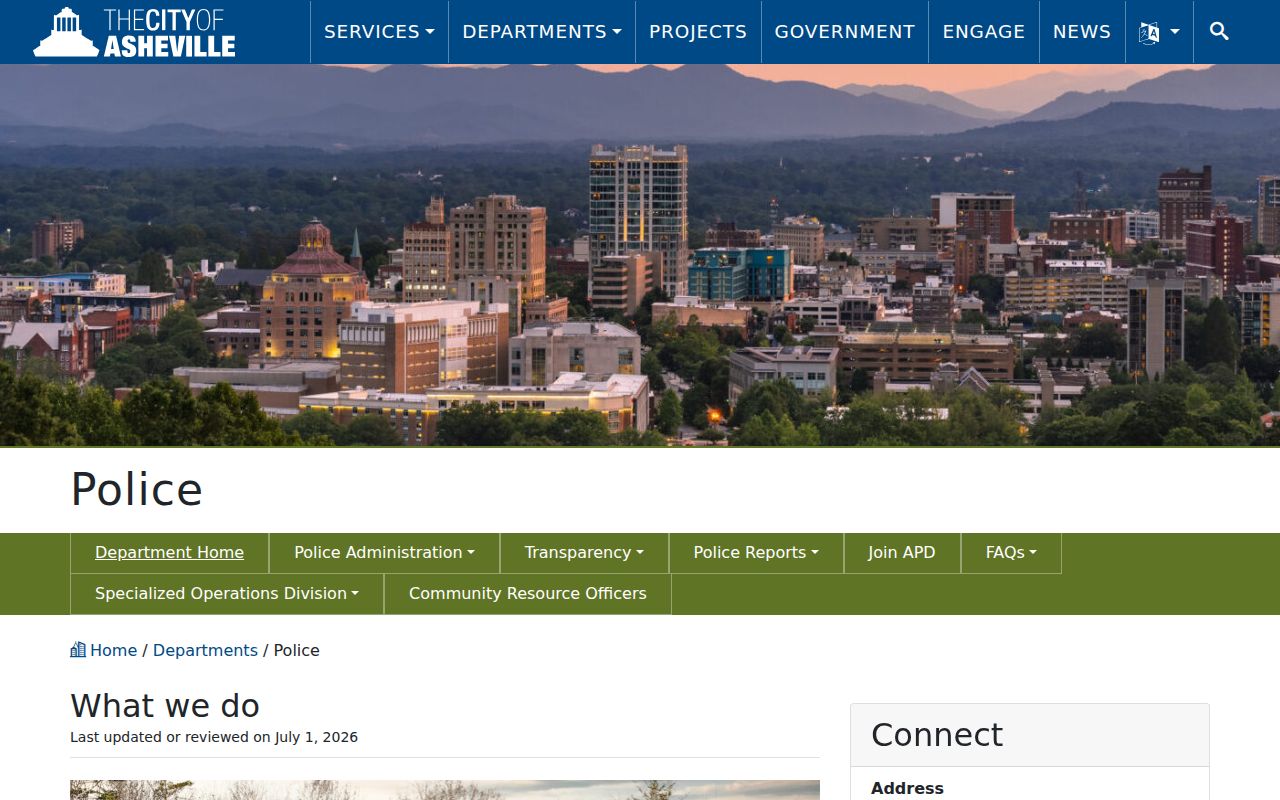
That city contact is appropriate for an APD report, while the Clerk and Sheriff remain the custodians for court and custody files.
Asheville Police Records
100 Court Plaza
Asheville, NC 28801
Records: 828-259-5870
Main: 828-252-1110
Call to confirm the precise counter hours.
Find Asheville Report Numbers
A person who does not know an APD case number can use SimpliCity or Community Crime Map as a discovery tool. Search by the event's approximate date and location, note the APD identifier, then place that number into Police-to-Citizen. SimpliCity offers radius searches described by the city from one-eighth mile through one mile. Community Crime Map can display a map or grid, incident type, location type, block address, and date or time. It also offers neighborhood email reports.
These Asheville dashboards reflect reported and published events. They are not court conviction lists. The event label may describe the first report rather than the charge later filed by a prosecutor. If the goal is to understand the outcome, take the case number or party name into Buncombe eCourts after checking the APD source. The city map can point to the incident; the Clerk's docket shows what happened in court.
Note: A map marker helps locate an event, but it does not establish guilt or replace the source report.
Booking and Arrest Records in Asheville
APD does not operate a separate city jail for this record trail. A custodial arrest in Asheville is booked at the Buncombe County Detention Facility at 20 Davidson Drive. The arresting agency creates the event record, while City-County Identification and detention staff create the booking entry, identity data, fingerprints, photograph, charge entry, bond information, and custody status. A magistrate handles the initial judicial process and release terms. Only a judicial official can set or change bail.
Search APD P2C for the Asheville event, then use Buncombe Sheriff Recent Arrests and Inmate Inquiry for the custody layer. A recent arrest and a current inmate result are not the same dataset. Release and transfer can remove a person from current custody even when an arrest card remains. The broader Buncombe County arrest search explains the county booking channels in more depth. Neither screen proves a conviction, and the filed charge can differ from the intake allegation.
Asheville JustFOIA Record Requests
Asheville launched JustFOIA on July 1, 2025 for broader city public-record requests. The portal permits submission and tracking without creation of an account. A useful request identifies the department, record category, date range, names or key terms, known report number, and preferred format. The city asks requesters to supply a clear time period, topic, and relevant staff when known. Questions about prior or completed requests can go to opengov@ashevillenc.gov.
The city's JustFOIA request form shows how Asheville accepts a request online.
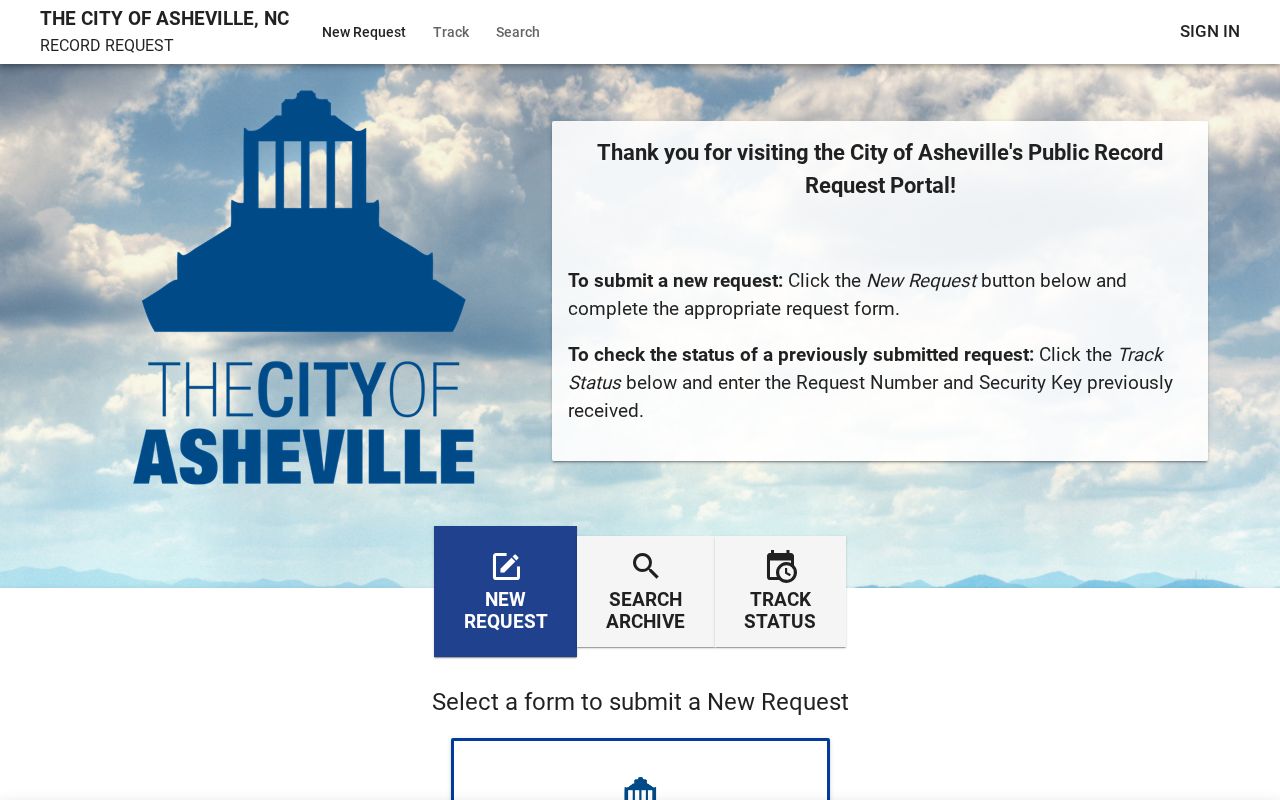
The form is useful when a published APD record cannot be downloaded or when the request reaches a different city department.
The official portal announcement confirms the no-account feature and the launch date.
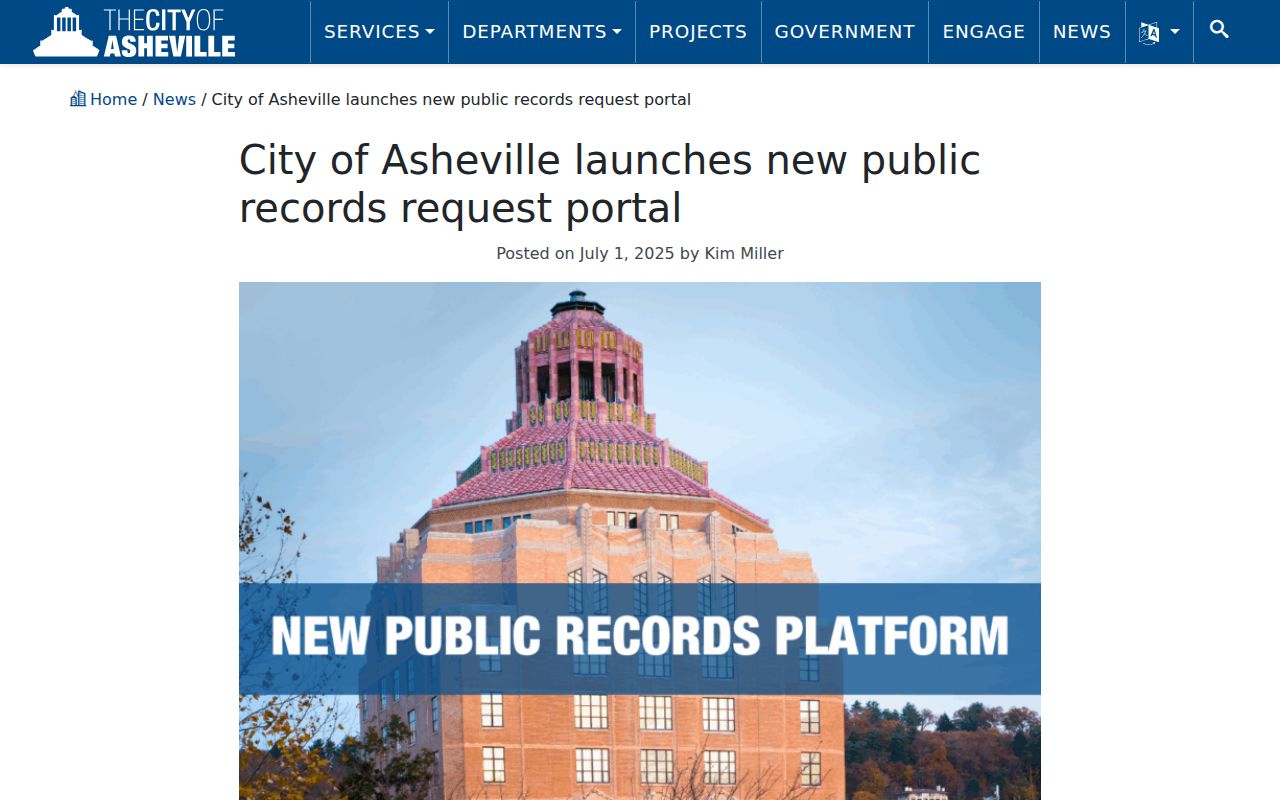
This newer route should be used instead of relying on an old request instruction that predates the portal.
The Asheville Municipal Court File
There is no separate Asheville municipal criminal court. North Carolina uses a unified General Court of Justice. Asheville ordinance citations, misdemeanors, and preliminary felony matters route to Buncombe County District Court; Superior Court hears felony trials. Both operate through the Buncombe County Courthouse and the Clerk at 60 Court Plaza. The phrase “Asheville municipal court” can therefore send a search to the wrong custodian if it is taken as the name of a city court that does not exist.
The court file is searched through North Carolina eCourts or requested from the Buncombe Clerk. It can show the filed charge, case number, hearings, attorneys, case status, disposition, judgment, and financial entries where public. For full docket detail and certified copies, use the Clerk rather than asking APD to create a court record.
| Court Name | Buncombe County District Court and North Carolina Superior Court |
|---|---|
| Case Types Heard | District Court handles misdemeanors, infractions, and preliminary felony stages; Superior Court hears felony trials |
| Case Lookup Channel | North Carolina eCourts Portal or the Buncombe Clerk of Superior Court |
| What the Docket Shows | Filed charges, events, hearings, status, disposition, judgment, and public financial entries |
| Copies and Certification | The Clerk supplies court copies and the certified county criminal record search |
Who Holds Asheville Criminal Records
Custody follows authorship. APD holds its police narrative and city event data. Buncombe County, not the city, holds 911 records. The Sheriff and detention staff hold booking and current custody data. The Clerk holds District and Superior Court files. NCSBI holds fingerprint-linked state history, while the North Carolina Department of Adult Correction holds sentenced prison and supervision information. Asking the wrong Asheville office can delay a search even when the record itself is public.
The city's public-records guidance routes requesters among these custodians.
The routing distinction is especially important for 911 calls and criminal court files, which Asheville does not maintain.
| Record | Custodian | Best first route |
|---|---|---|
| Police incident report | Asheville Police | APD P2C or JustFOIA |
| 911 record | Buncombe County | County public-record request |
| Booking or custody | Buncombe Sheriff | Sheriff P2C |
| Criminal court case | Buncombe Clerk | eCourts or Clerk counter |
| Fingerprint history | NCSBI | Subject's Right to Review |
How Asheville Records Reach the County
An Asheville incident can create several linked records, but no screen contains the whole story. APD records what its officers reported. A custodial arrest creates a Buncombe booking. The magistrate begins the court process, and the Clerk records the filed case in eCourts. Qualifying fingerprints and later reported dispositions may enter the NCSBI criminal-history chain. Timing and different identifiers can cause gaps between the systems.
Record flow: Asheville Police Department › Buncombe County District or Superior Court › North Carolina State Bureau of Investigation
For recent activity, start with APD and booking sources. For the legal outcome, read each charge's disposition in eCourts and confirm it with the Clerk when accuracy matters. For a subject's own statewide fingerprint-associated record, use NCSBI Right to Review. A local incident search is broader in event detail but narrower in geography; the state product is broader in geography but is a different access channel.
Asheville Crime Data Versus Records
Asheville publishes Crime Summary, Crime Trends, gun-discharge, traffic-stop, and response-to-resistance dashboards. Downloadable city data may appear in spreadsheet or geospatial form. These tools help a reader understand a place, time span, or reported incident pattern. They do not identify a final court result. Counts can reflect reporting practices, police activity, date filters, and later changes to charges.
Use dashboards as context, not as proof about a person. A published event should be tied to the source APD report, and any prosecuted matter should be followed into Buncombe eCourts. That distinction protects against the most common Asheville record error: calling a police label a conviction. It also explains why city trend totals should not be compared with jail population or court disposition totals as though all three measure the same thing.
Asheville Record Counters at Court Plaza
Asheville concentrates several record custodians near Court Plaza, yet their roles stay separate. APD Records is at 100 Court Plaza. The Buncombe courthouse and Sheriff administration are at 60 Court Plaza, with the Clerk serving District and Superior Court files. Detention and the criminal Magistrate's Office are nearby at 20 Davidson Drive. City-County Identification at 52 Coxe Avenue provides fingerprints and advertises a Buncombe-only court-case check.
A person going to the courthouse should allow time for security. Public entry is at street level, bags are screened, and visitors pass a metal detector. The Clerk's published courthouse number is 828-259-3400, with weekday hours of 8 a.m. to 5 p.m. These practical details matter because older or non-imaged documents may require the counter even when eCourts supplies the index. Check the responsible office before visiting instead of moving between buildings with the same request.
Asheville Record Access Rules
North Carolina Public Records Law applies to Asheville agency records, but access depends on the file. G.S. 132-1 broadly defines public records. G.S. 132-1.4 treats the complete criminal investigation as generally nonpublic while making specified incident and arrest facts available. Clerk files are public under G.S. 7A-109, subject to statutory limits and remote-access rules. Juvenile, victim-sensitive, sealed, expunged, tactical, and active investigative material may be withheld or redacted.
The city is required to provide an existing public record, not create a new report or analysis under G.S. 132-6. A focused request helps staff locate what exists. Give the event, date range, location, department, report number, and desired format. If a search returns nothing, ask whether the record is held elsewhere, not yet published, or restricted.
Key Statutes:
G.S. 132-1 defines public records subject to specific exceptions.
G.S. 132-1.4 separates public incident facts from protected investigative material.
G.S. 7A-109 governs public access to Clerk records and remote limits.